

In the opening months of 2020, headlines warned of historic market collapse. By December, the S&P 500 had posted one of its strongest years on record.
In early 2022, experts predicted inflation would be “transitory.” It wasn’t.
Fast forward to today, and the pattern continues: every economic data point, every Federal Reserve decision, every geopolitical shift generates a fresh wave of predictions, counter-predictions, and calls to action. Finding financial clarity in uncertain markets has never been more challenging – or more necessary.
There’s no shortage of noise out there right now. Interest rates, inflation data, market volatility, election cycles – almost every headline feels like it’s demanding something from you.
Act now. Brace for impact. Pivot your strategy.
The financial media ecosystem has evolved into a 24-hour cycle of urgency, where calm reflection is often drowned out by the loudest voice in the room.
But here’s what I’m observing from conversations with clients and prospects: people aren’t looking for more predictions. They’re looking for financial clarity in uncertain markets.
The Prediction Problem
Warren Buffett famously said, “Forecasts may tell you a great deal about the forecaster; they tell you nothing about the future.” Yet the investment world remains obsessed with forecasting. Turn on financial television, scroll through your news feed, or attend an investment conference, and you’ll encounter no shortage of certainty about what comes next.
The problem?
These predictions are consistently wrong, or at least, wrong enough to be concerning.
Consider some history:
-
1987 Stock Market Crash The market dropped 22% in a single day. Experts predicted years of economic disaster. Within two years, the market had fully recovered and kept climbing.
-
Dot-Com Bubble (2000) Analysts said internet stocks “can’t go down” and traditional profit metrics didn’t matter anymore. The tech-heavy NASDAQ then crashed 78% over the next two years.
- Y2K Crisis (2000) Experts warned computers would crash globally at midnight on January 1, 2000, causing financial collapse. Nothing happened.
The common thread?
Certainty in the face of uncertainty. And for investors who made major portfolio decisions based on these predictions, the cost was real.
John Kenneth Galbraith, the renowned economist, put it bluntly: “The only function of economic forecasting is to make astrology look respectable.”
What People Actually Need
In my conversations with clients, especially during volatile periods, I’ve noticed a shift in what people are asking for. They’re no longer asking, “What’s going to happen next?” Instead, they’re asking:
- What should I actually pay attention to?
- What can I safely ignore?
- How do I move forward with confidence, even when things feel uncertain?
These are fundamentally different questions. They acknowledge uncertainty rather than trying to eliminate it. They prioritize clarity over prediction. They recognize that success in investing isn’t about being right about the future – it’s about being prepared for multiple possible futures.
This shift represents a maturation in investor thinking, and it’s exactly where good financial advice becomes invaluable. Finding financial clarity in uncertain markets isn’t about having all the answers – it’s about knowing which questions actually matter. If you’re experiencing this shift in your own thinking, I’d welcome a conversation about what that looks like for your specific situation – connect with me here!
The Real Value of Financial Partnership
Let me be clear: good financial advice isn’t about having better predictions. It’s not about claiming to know where interest rates will be in six months or which sectors will outperform next quarter.
The real value of financial partnership, especially in noisy environments like we’re experiencing now, is helping you respond to what actually matters for your specific situation, rather than reacting to every headline. This is how you achieve financial clarity in uncertain markets.
This means:
1. Creating a Personalized Filter
Not all news is equally relevant to your financial life. A retiree living on portfolio income should think very differently about interest rate changes than a 35-year-old in accumulation mode. A business owner has different risk exposures than a W-2 employee. Your filter needs to be calibrated to your goals, your time horizon, and your values, not to generic market commentary.
2. Distinguishing Signal from Noise
The media has an incentive to make everything feel urgent and consequential. But in reality, most market movements are noise – random fluctuations that have no bearing on long-term outcomes. A skilled advisor helps you identify the genuine signals: changes in your personal circumstances, shifts in tax law, or legitimate adjustments needed in your asset allocation. Everything else is just noise.
Peter Lynch, the legendary Fidelity fund manager, noted: “Far more money has been lost by investors preparing for corrections, or trying to anticipate corrections, than has been lost in corrections themselves.”
3. Maintaining Perspective During Extremes
Markets have a way of making the current moment feel uniquely dangerous or uniquely opportunistic. In bear markets, it feels like things will never recover. In bull markets, it feels like the good times will never end. History shows both perceptions are wrong. An advisor’s job is to provide institutional memory – to remind you that this too shall pass, and that your long-term plan was built to weather exactly these kinds of environments.
4. Making Values-Based Decisions
The best financial decisions aren’t purely mathematical. They involve trade-offs between competing priorities: security versus growth, spending today versus leaving a legacy, career risk versus entrepreneurial upside. These decisions require values clarification as much as financial modeling. A good advisor helps you think through these trade-offs in a structured way, ensuring your financial plan actually reflects what matters most to you.
The Human Wealth™ Approach
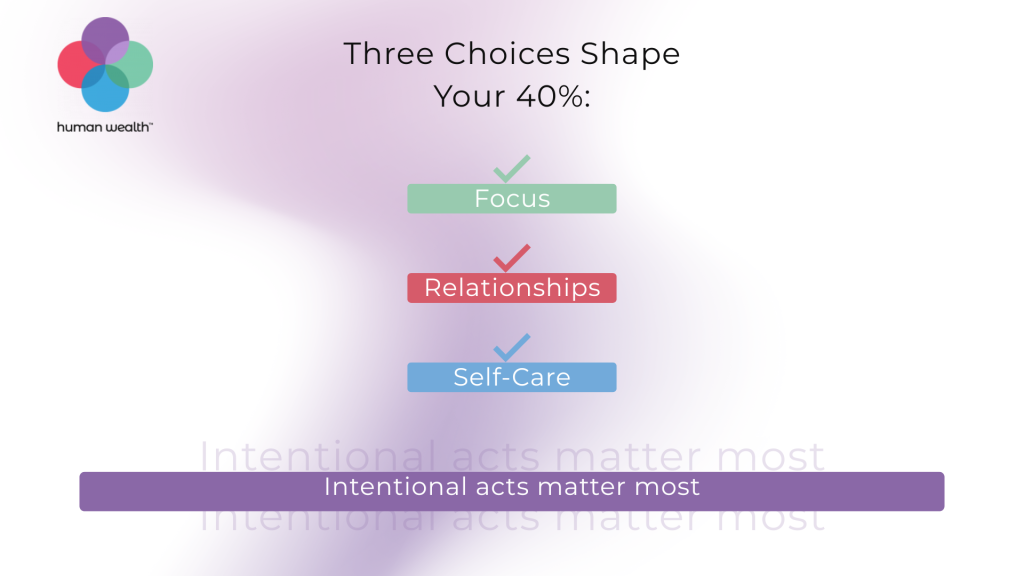
This is precisely why our team at WMBC Financial developed the Human Wealth™ philosophy. Traditional wealth management often starts (and sometimes ends) with portfolio construction and asset allocation. But that’s backwards.
Human Wealth™ starts with you – your unique passions, your wellness goals, your definition of success, your vision for impact. It recognizes that wealth isn’t just a number on a statement. It’s a tool to create the life you want to live.
Through this approach, we work together to:
- Identify what truly matters – beyond the generic “comfortable retirement” to the specific experiences, relationships, and contributions that give your life meaning
- Align your resources – ensuring every financial decision moves you closer to those priorities rather than away from them
- Create integrated strategies – where your investments, tax planning, estate work, and risk management all work together toward your Human Wealth objectives
- Build sustainable confidence – not through prediction, but through clarity about your path and adaptability when circumstances change
This isn’t about handing you a pre-packaged solution or giving you “the reins” and saying good luck. It’s about genuine partnership – where your expertise about your life combines with our expertise in financial strategy to create something truly customized.
If the Human Wealth™ philosophy resonates with how you think about your financial life, let’s explore what it could look like in practice – reach out here.
Clarity as a Competitive Advantage
In an information-saturated world, financial clarity in uncertain markets has become a scarce resource, and therefore, a competitive advantage.
Consider what happens to investors who lack this clarity:
- They check their portfolios obsessively, turning long-term investments into sources of daily stress
- They make reactive changes based on headlines, often buying high and selling low
- They second-guess their decisions constantly, creating a cycle of anxiety and poor timing
- They abandon sound strategies at exactly the wrong moment, crystallizing losses that could have been temporary
Now consider the alternative – an investor with a clear, well-articulated plan and a trusted filter:
- They know what they’re invested in and why
- They understand which events actually require a response and which don’t
- They can tune out the noise because they trust their process
- They make decisions from a place of confidence rather than fear or greed
This isn’t about being emotionless or detached. It’s about channeling emotional energy into the things you can control – your savings rate, your asset allocation, your tax efficiency, your estate plan – rather than the things you can’t, like next quarter’s GDP print or the Federal Reserve’s next move.
Moving Forward with Confidence
Morgan Housel, author of The Psychology of Money, writes: “The ability to do what you want, when you want, with who you want, for as long as you want, is priceless. It is the highest dividend money pays.”
That freedom, that sense of confidence and control, doesn’t come from having perfect information about the future. It comes from financial clarity in uncertain markets – having a clear understanding of what truly matters, a plan built around those priorities, and the discipline to stick with it when the noise gets loud.
Right now, the noise is particularly loud. Rate decisions. Inflation reports. Market corrections. Political uncertainty. Geopolitical tensions. The temptation to react is everywhere.
But the investors who will look back on this period with satisfaction aren’t the ones who reacted most quickly or most dramatically. They’re the ones who stayed focused on their long-term objectives, who distinguished between meaningful changes and temporary turbulence, and who had a trusted partner to help them maintain perspective.
A Different Kind of Conversation
If this way of thinking resonates with you – if you’re feeling the weight of the noise and looking for a clearer path forward – I’d welcome the opportunity to talk.
Not to make predictions about the market. Not to pitch you on the “strategy of the moment.” But to have a genuine conversation about what matters to you, what you’re trying to accomplish, and how we can structure your financial life to give you more confidence and less anxiety.
Because at the end of the day, that’s what good financial advice really delivers: not certainty about an uncertain world, but financial clarity in uncertain markets and confidence about your path through it.
Let’s start that conversation – connect with me here.
To clarity and confidence,
David Coles
President & Wealth Advisor
WMBC Financial
The views expressed in this article are those of the author and do not constitute financial advice. Every individual’s financial situation is unique, and you should consult with a qualified financial professional before making investment decisions.